In 1937, a man named Sylvester Goldman placed a folding basket on a modified folding chair and added wheels. He called it the shopping cart. Within a decade, his invention had spread to grocery stores across the United States. Within a generation, it was in every supermarket on earth.
For the next 89 years, the fundamental design went almost entirely unchanged. The basket, the frame, the handle, the wheels. An object used by billions of people, millions of times per day, that looked essentially identical in 2024 to how it looked in 1950.
Then a Polish company changed it.
From a Folding Chair to a Global Medium
Goldman’s insight was mechanical: give shoppers a way to carry more without carrying anything. The cart solved a physical problem.
Solution SCA’s insight was informational: the shopping cart handle — the one object every shopper in every grocery store touches for the entire duration of their visit — was the most valuable piece of real estate in retail media. And it had been blank for nearly a century.
The company was founded in 2012 in Klaudyn, near Warsaw, but the idea had been developing since 2006, when founder Piotr Sobczak first recognized the potential of mobile digital carriers mounted on shopping cart handles. The technology of the time couldn’t support it. The company spent the next five years building the concept into something that could actually work in the hostile conditions of a grocery store: temperature swings, rain, constant physical impact, and the expectation that a single device would function reliably for years without daily maintenance.
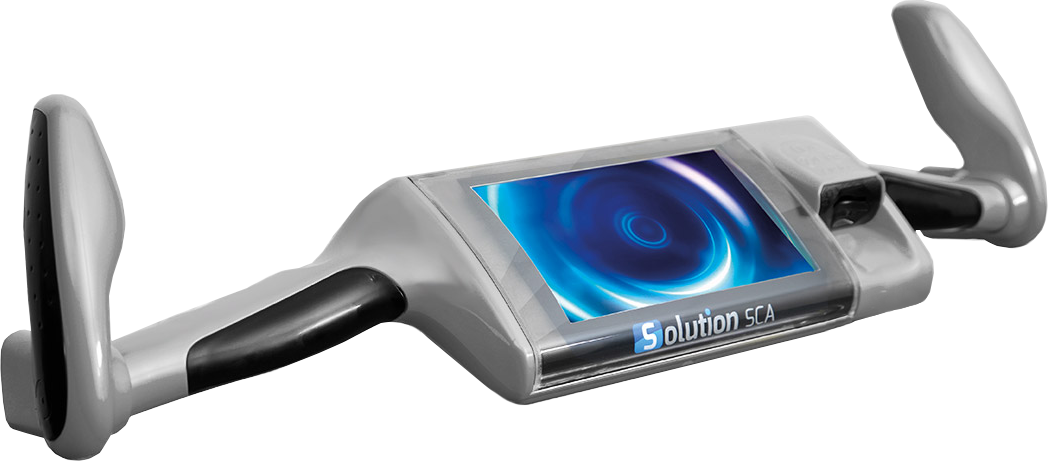
The result was One To One — a multimedia display system embedded in a shopping cart handle.
What One To One Actually Does
The name is deliberate. Every screen communicates directly and individually with each shopper. Not with a demographic. Not with a store zone. With the specific person holding the handle, based on where they are in the store at that precise moment.
The One To One system works on a principle the company calls JOS — Just One Socket. A single power socket in the store runs the entire network. There are no technical agreements required, no infrastructure modifications, no months-long installation process. Replacing an old handle with a One To One handle takes approximately one minute per cart.
The device is battery-powered and wireless. The screen activates when the cart is in motion and goes dark when stationary — a design decision that preserves battery life and concentrates advertising exposure during active shopping moments. A single charge lasts a minimum of one week under typical conditions; newer generation devices are extending that to two weeks to a month.
All One To One units communicate wirelessly with Immensus — Solution SCA’s proprietary CMS (Content Management System), accessible from anywhere in the world. Unlike standard in-store screens that loop content from a USB drive, Immensus delivers targeted content updates directly to individual devices within minutes, even mid-campaign. Campaigns can be scheduled not just by date, but by specific day and hour — giving advertisers the same precision targeting capabilities as online media, applied to the physical store environment. The platform generates daily impression reports, measures the number of customers in-store and in specific zones, and analyzes shopper behavior by time of day, age, and gender. Security is built into the hardware architecture. Each One To One device generates an individual encryption key, meaning that a compromised device cannot expose the rest of the fleet — a level of security assurance uncommon in retail media hardware.
The system is designed to display messages that adapt to the shopper’s location within the store. A shopper entering the dairy section sees a different message than the same shopper who walked through the snack aisle ten minutes earlier. Zone-based content delivery — triggered by where the cart is, not just who is carrying it — is what separates One To One from static in-store advertising and from digital screens mounted on walls.
10 Years of Development. One World Premiere.
The first production version of the equipment, along with the management system, was completed in 2015. That same year, Solution SCA signed its first permanent contract with a retail chain.
In 2017, Solution SCA went public with One To One for the first time — at Euroshop 2017 in Düsseldorf, the world’s largest trade fair for the retail industry. The response confirmed the scale of the opportunity: more than 150 companies from 51 countries expressed interest in cooperation. It was a world première for a product category that hadn’t existed before.
In 2018, the company completed its transformation into a joint-stock company and began full commercial operations. In 2020, Solution SCA introduced One To One Green, a redesigned device that operates for a full week or more between charges under all weather conditions — making large-scale retail chain deployment genuinely practical. In 2021, the platform gained customer location and traffic analysis capabilities, expanding One To One from a pure advertising medium into a retail intelligence tool.
By 2022, Solution SCA had produced its 10,000th One To One monitor.
Certified, Patented, and Deployed Across Europe
The One To One system operates under Solution SCA’s own patents. The hardware meets industrial manufacturing standards and carries the certifications required for each market.
In 2024, Solution SCA received FCC certification (ID: 2BADWONETOONE) for the United States and ISED certification (ID: 313230OTO024) for Canada — a prerequisite for commercial deployment in North American retail. The FCC registration (ID: 2BADWONETOONE) covers the device as a Digital Transmission System, clearing the path for One To One to enter the world’s most competitive grocery retail market.
Active deployments span multiple countries:
Poland — E.Leclerc Radom, where the system completed a six-month testing period and has since been extended to a permanent installation. Poland remains Solution SCA’s home market and the proving ground for new platform capabilities.
Sweden — Two deployments in the Stockholm region, including the Barkarby store, where 225 One To One units are in active operation, presenting millions of messages per month. A second Swedish installation followed in November, with over 200 units deployed.
Austria — Deployments at SPAR Market Puch-Urstein near Salzburg and at Eurospar Innsbruck, where Solution SCA collaborated with the University of Innsbruck team led by Prof. Dr. Mathias Streicher on research into shopping behavior and in-store media effectiveness.
Andorra — A signed contract with E.Leclerc Andorra, expanding the network into one of Europe’s most distinctive retail markets.
The company has also established a strategic partnership with POS Media Poland, the European leader in shopper marketing, connecting One To One to an established pan-European retail media distribution network.
NRF 2025: Global Validation
In January 2025, Solution SCA exhibited at the National Retail Federation Big Show in New York — the largest annual gathering of retail industry leaders in the world, drawing tens of thousands of attendees from over 100 countries.
For a company based in Klaudyn, Poland, presenting to the global retail industry on the floor of the Javits Center was a significant moment. The response aligned with what Euroshop 2017 had suggested eight years earlier: the One To One concept is unique on a global scale.
NRF 2025 confirmed that Solution SCA was not building a regional product. It was building global infrastructure for a channel — in-store cart media — that no competitor had yet defined at scale. The interest generated at the show demonstrated that the North American market, following FCC certification, represented a substantial near-term expansion opportunity.
The Gap in Retail Media That Nobody Had Filled
The story of One To One is also the story of a gap that persisted for decades because the technology to fill it didn’t exist.
In-store retail media has been a concept since at least the 1980s — fixed point-of-purchase displays, static aisle signage, shelf talkers. Digital screens arrived in stores in the 2000s and 2010s, mounted on end-caps, at checkout lanes, on refrigerator doors. All of these formats share a structural limitation: they are fixed. They reach the shopper only when the shopper happens to be near them. A screen at the store entrance reaches the shopper once. A screen at the dairy case reaches the shopper only if they visit dairy.
The shopping cart is different. It travels the entire store with the shopper. A shopper who visits twelve aisles over forty-five minutes carries One To One through all twelve of those aisles. The reach is not dependent on the shopper happening to look in the right direction at the right moment. It is persistent across the entire shopping journey.
This is why the handle — not the aisle screen, not the end-cap display, not the checkout monitor — is the most valuable physical surface in grocery retail. And why Sylvester Goldman’s invention, unchanged for 89 years, was waiting for exactly what Solution SCA built.
What Comes Next
The retail media market is in the middle of a structural shift. In 2026, 76% of purchases still happen in physical stores, yet the overwhelming majority of retail media budgets remain allocated to online channels. Even though over 95% of food and beverage spending happens in-store, over 99% of retail media advertising remains online — a gap driven not by effectiveness but by measurement confidence.
That gap is closing. Grocery chains are investing in closed-loop measurement that connects in-store ad exposure to basket-level outcomes. By 2026, retailers are expanding in-store media through deeper partnerships with signage and content platforms, and using AI to tailor messages to real-time traffic and shopper behavior. Advertiser confidence in in-store retail media is rising as the measurement infrastructure matures.
Solution SCA has been building the physical and software infrastructure for this moment since 2011. One To One is not a response to the retail media trend — it preceded the industry’s recognition of the trend by nearly a decade.
With FCC certification secured, NRF validation on the record, an active European installation base, and the Immensus platform managing deployments from a single interface anywhere in the world, Solution SCA enters the in-store retail media expansion phase with a product category it invented and a technology no competitor has yet replicated at scale.
The shopping cart handle has been blank for 89 years. It isn’t blank anymore.
In 2026, Solution SCA joined the MAGO Group, marking a new phase of organizational scale for the company. The One To One system has been rebranded as Clever — reflecting both the product’s evolution and its integration into a broader retail technology ecosystem. The underlying technology, patents, and Immensus platform remain unchanged.
About Solution SCA
Solution SCA, a member of the MAGO Group since 2026, is a Polish technology company specializing in smart shopping cart media systems. Founded in 2012 and headquartered in Klaudyn near Warsaw, the company designs, develops, manufactures, and services the Clever system (formerly One To One) — a patent-protected digital display integrated into the shopping cart handle, managed by the proprietary Immensus CMS platform. Solution SCA’s systems are deployed across retail chains in Poland, Sweden, Austria, and Andorra, with FCC certification (ID: 2BADWONETOONE) for the United States and ISED certification (ID: 313230OTO024) for Canada.